


Disruption of sleep architecture: causes, consequences and countermeasures
The healing power of silence
What is meant by normal and disturbed sleep architecture?
Sleep architecture refers to the structured, orderly sequence of the different sleep phases during a night. It is the subtle, cyclical interplay of light, deep, and REM sleep that follows a similar pattern, albeit with highly individual variations, in every person. This cycle typically occurs four to seven times per night, with each phase usually lasting between 90 and 110 minutes. Sleep architecture changes the longer one sleeps.
Physical deep sleep dominates in the first half of the night.
Towards morning, the cycles become shorter and the proportion of mental REM sleep increases significantly.
A disrupted sleep architecture leads to so-called sleep fragmentation – an interruption of the natural sequence/interplay of the individual phases. This results in repeated periods of wakefulness, often lasting only a few seconds. Or we experience a disproportionately high number of light sleep stages.
What are the causes of such sleep disorders?
Numerous factors can play a role here: breathing disorders (sleep apnea), shift work, too much alcohol or nicotine, jet lag, movement disorders such as restless legs syndrome (RLS), external factors such as noise, light, temperature fluctuations, etc.
Additional triggers include internal factors such as pain, urinary urgency, and psychological stress. Or serious neurological diseases such as Myalgic Encephalomyelitis (ME) – often in combination with Chronic Fatigue Syndrome (ME/CFS).
The core processes and their disturbances
Deep sleep loss: If deep sleep phases are lacking, physical regeneration, cell renewal and the immune system suffer.
REM sleep deprivation: REM sleep is essential for emotional processing and memory formation. If it is lacking, those affected are often irritable, stressed, and psychologically resilient.
Increased stress response: Frequent awakenings at night, for example due to noise or sleep apnea, put the body on high alert. Pulse and blood pressure rise.
What are the immediate consequences of a disrupted sleep architecture?
The body is deprived of the crucial, continuous recovery phase; it reacts with stress and the release of hormones, which leads to massive daytime fatigue, poor concentration, decreased performance, and emotional instability the next day.
In people suffering from ME/CFS, sleep disturbances often lead to a drastic, sometimes irreversible, worsening of overall symptoms (a "crash"). Details can be found here.
What are the long-term consequences of disrupting sleep architecture?
If our sleep patterns are permanently disrupted, the body and mind are deprived of essential recovery phases. In the long run, this leads to serious damage.
Mentally, there is a risk of massive concentration problems, memory gaps and faulty emotional regulation, which greatly increases the risk of depression and anxiety disorders.
Furthermore, the risk of Alzheimer's disease increases because the brain lacks the deep sleep necessary for breaking down toxic metabolic products.
Physically, a persistent lack of sleep leads to chronic high blood pressure, which drastically increases the risk of heart attacks and strokes.
At the same time, the "hunger hormones" get out of control - those messenger substances that signal to the brain: "I am hungry." Frequent cravings, resulting weight gain and an increased risk of type 2 diabetes are the consequence.
Furthermore, the immune system weakens considerably, making the body extremely susceptible to infections.
Sleeping cabins block out sensory stimuli
There are a number of helpful tips for dealing with sleep problems. This starts with lifestyle adjustments and extends to good sleep hygiene. This includes consistent wake-up times, an optimal room temperature (around 16–18 °C), and avoiding alcohol and caffeine late in the evening. Light exercise also promotes sleep, while strenuous activity before bedtime should be avoided. Regular bedtime rituals such as reading or relaxation exercises signal to the body that it's time to rest. For mild symptoms, herbal remedies like valerian or lavender can also be beneficial.
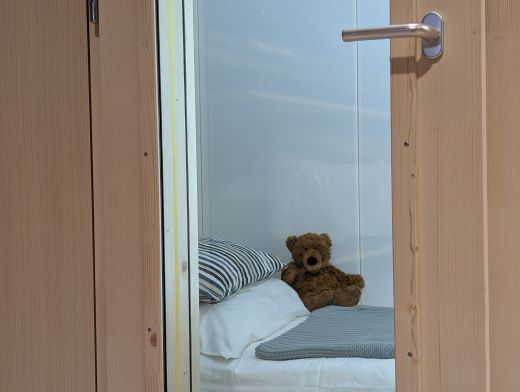
What if all that doesn't help? – People with noise and light sensitivity, in particular, need a sleeping environment that is as shielded as possible from sensory stimuli. STUDIOBOX sleeping cabins – whether the STANDARD model or the biological alternative ROSI – offer precisely this environment. They are massively soundproofed (down to -53 dB), made mostly or entirely of wood (compare: ROSI production), and beneficial to long-term health.
Web links:
https://www.sleepfoundation.org/stages-of-sleep
https://www.health.harvard.edu/sleep/what-is-sleep-architecture
https://www.usz.ch/krankheit/schlaf-wach-stoerungen/
https://www.alzheimer-forschung.de/demenz/pflege/umgang/schlaf/
https://www.sigma-zentrum.de/aktuelles/die-auswirkungen-von-schlaf-auf-psyche/